.svg)

.png)
Mechanical Engineering
From mechanics and materials to thermodynamics, controls, and design, cadets who choose to pursue mechanical engineering degrees at VMI master the science of energy and motion while cultivating the confidence to lead engineering teams in demanding environments.
The department delivers a comprehensive, practice-focused curriculum grounded in ethical decision-making and professional standards. Faculty bring advanced scholarship and real-world experience from defense, energy, manufacturing, and research sectors, with expertise spanning structural analysis, heat transfer, fluid mechanics, robotics, design for manufacturability, systems engineering and more. Cadets can also expand their learning and experiences by challenging themselves to graduate with honors in the discipline.
Cadets who successfully complete the department's rigorous program earn the B.S. in mechanical engineering. with optional concentrations in aerospace engineering and nuclear engineering. Career paths include aerospace, power, HVAC, bioengineering, manufacturing, management, and a host of others.
Program Accreditation
The Mechanical Engineering program is accredited by the Engineering Accreditation Commission of ABET, https://www.abet.org, under the commission's General Criteria and the Program Criteria for Mechanical and Similarly Named Engineering Programs.
This recognition places VMI among leading mechanical engineering colleges and affirms the strength of our outcomes-focused approach.
Degrees and Programs
Major(s): Mechanical Engineering
Degree(s): Bachelor of Science (B.S.)
Concentration(s):
Minor(s):
- n/a
Real-World Experience
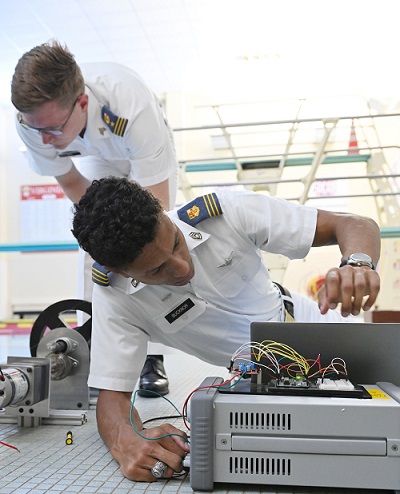
A unique feature of the mechanical engineering curriculum is the capstone design course through VMI's Cooperative Engineering Center (CEC). Cadet teams work on real-world design projects supplied by local industries who are members of the CEC with an industry engineer and faculty member as advisors. Cadets write a formal design report and give an oral report to supporting industry. The department also sponsors a student section of the ASME (American Society of Mechanical Engineers), providing opportunities for professional activities, experiences, and networking.
These experiences, along with internship opportunities, prepare cadets for employment, connecting classroom theory to practice in aerospace, automotive, energy, logistics, and defense fields.
Structured for Success
The VMI Department of Mechanical Engineering prepares graduates for life after VMI through a continually improving curriculum of courses in engineering, related sciences, mathematics, and humanities which will ensure that our graduates are prepared to meet our educational objectives.
Within a few years of graduation, VMI mechanical engineering graduates are on course: serving with distinction in industry or the military, advancing in graduate study, and contributing globally with unwavering ethical standards. They apply mathematics, science, and engineering to thermal and mechanical systems; design and conduct experiments; interpret data; and employ modern analytical and computational tools. These young professionals communicate with clarity, work effectively on teams, embrace responsibility, and commit to lifelong learning.
The educational objectives of the VMI Mechanical Engineering Program are to produce graduates, who will, within a few years of graduation,
- have successful careers in industry or the military, or be successfully engaged in post-graduate or advanced educational studies, and
- be responsible global contributors who uphold strict ethical standards and who continue to develop their professional skills through sustained engagement in lifelong-learning activities.
The potential of our graduates to realize our educational objectives depends on the skills and abilities they have developed through the ME curriculum. Therefore, the department has identified specific Educational Goals and supporting Student Outcomes (SO), related to those skills and abilities, that each cadet should possess by graduation.
Educational Goal 1
Graduates will have the ability to apply the knowledge of mathematics, science, and engineering to engineering problems in the thermal and mechanical areas.
SO 1.1 Graduates will have the ability to apply the knowledge of mathematics (through statistics, linear algebra, multivariate calculus and differential equations), science (through chemistry and calculus-based physics), and engineering to engineering problems in the thermal and mechanical design areas.
SO 1.2 Graduates will have the ability to analyze and design mechanical and thermal systems, components and processes.
SO 1.3 Graduates will have the ability to design and conduct experiments, and to analyze and interpret experimental results.
SO 1.4 Graduates will have the ability to use modern computational and analytical techniques, skills, and tools.
Educational Goal 2
Graduates will possess the professional skills and awareness necessary to responsibly practice engineering in both a technical and societal context.
SO 2.1 Graduates will have effective oral and written communication skills.
SO 2.2 Graduates will have the ability to effectively function on teams.
SO 2.3 Graduates will have an understanding of their professional and ethic responsibilities.
SO 2.4 Graduates will recognize their need of life-long learning and will possess the ability to engage in life-long learning.
Mechanical Engineering in the News
Find out more about the department's cadets and faculty in recent VMI news.
Cadets in Technical Writing and Statics Courses Collaborate on Design for Humanity Projects
Through ongoing interviews and discussions, cadets in ERH 314 learned about and translated mechanical designs developed by the mechanical engineering cadets for open-source reports accessible to engineering departments at other colleges and universities.
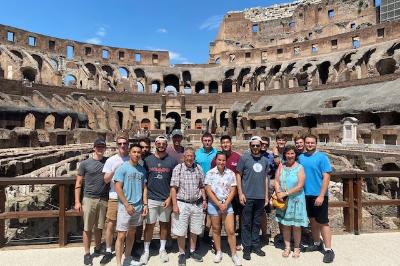
One of the primary goals of this program is to give engineering cadets, who don’t often get the chance to study abroad due to their pre-requisite driven curriculum, the opportunity to develop cultural competency skills and learn to live and work in a multi-cultural, multi-national society.